Frame the Fizz: Filming Your Garden Fireworks Without the Shaky Blur
Photo: RambodR, CC BY-SA 3.0, via Wikimedia Commons
Every year it happens. The sky lights up, everyone gasps, someone films the whole thing on their phone, and the resulting clip looks like a traffic cone exploding behind a bathroom window. Fireworks are genuinely hard to capture — bright, fast, unpredictable and usually happening in near-total darkness. That is exactly why a little preparation pays off so handsomely.
Here is the Fawkingood approach to filming a garden display: set up early, lock everything down, stay out of the firing line, and resist the urge to fiddle.
Why fireworks break phone cameras
Automatic modes are trying to do something impossible. They see a dark sky, brighten everything up, and then a burst blows out to pure white. Night mode, clever as it is, tends to smear moving sparks into mush and adds a strange glow to everything around them.
The fix is to stop the camera guessing. Lock the focus and exposure before the first fuse is lit, then leave them alone. If your phone has a pro or manual mode, drop the ISO low (think 50 to 200) and let a slightly longer shutter do the work. On a tripod, two to four seconds will pull gorgeous light trails out of a fountain or a fan. Handheld, keep it to video and accept a little grain.
Get set before it gets dark
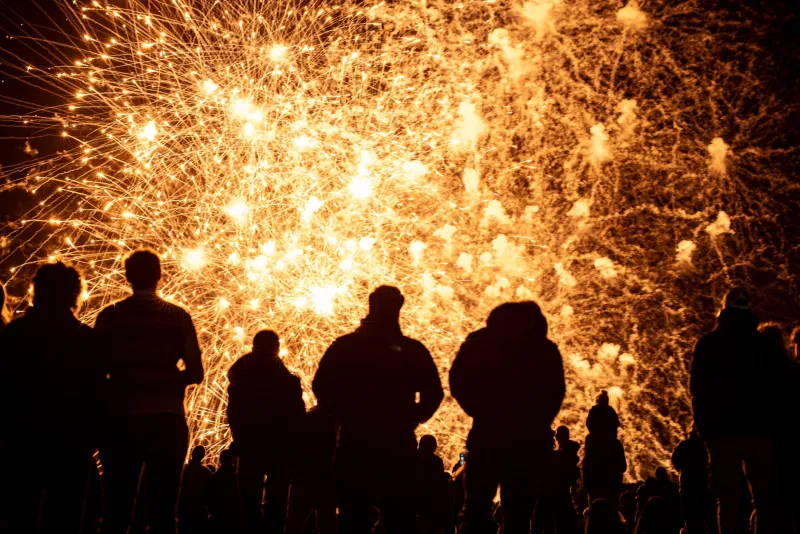
Scout your angle in daylight. You want a clear view of the sky above the launch area, plus something in the foreground to give the shot scale — a hedge, a chimney, a string of festoon lights, a silhouetted row of heads. A firework against a black void is a pretty pattern; a firework above your own shed is a memory.
Check where the smoke will drift. A light breeze blowing towards the camera will fog your footage within thirty seconds, so pick a spot upwind if you can. And confirm your sightline does not involve leaning over a fence, a wall or anything else that puts you closer to the launch site than the safety distance on the product label.
Framing: give the sky some company
Do not zoom. Digital zoom on a phone is a quick route to mush, and optical zoom pulls you into a narrower view of the sky just as the burst spreads wider than the frame. Instead, use your feet: stand further back and shoot wide.
Leave generous headroom. Fireworks open upwards and outwards, and the prettiest part of a burst is usually the top third of the explosion. If your first test frame has the launch site in the middle, you have aimed too high — put it in the bottom third and let the sky have the rest. Landscape suits a full barrage; portrait suits social. Shoot both, or shoot wide and crop later.
Lock it down: exposure and focus
Tap and hold on a distant light — a streetlamp, a lit window, a bright star — until your phone tells you the focus and exposure are locked. Then drag the exposure slider down two or three stops so the sky reads as properly black rather than grey soup.
Turn the flash off. Turn HDR off for video. If you are shooting stills, use a tripod and a timer or remote shutter so the phone does not move when you press the button. A cheap Bluetooth shutter release is one of the best fivers you will spend this season.
Tripods, cables and the safety dance
A tripod is brilliant right up until someone trips over it. Site it well outside the safety distance, away from the firing line and out of the route people will take to the back door. Weight the legs with a bag, tape down any trailing cable with gaffer tape, and keep the whole setup clear of where spent cases and sparks will land.
Keep the phone out of the heat and away from the launch area. Sparks and hot plastic do not mix with camera lenses. And if you are using long exposures, do not leave the camera running unattended while people are moving around nearby — you want to be watching the display, not your screen.
Sound that doesn't sound like a bin lorry
Phone microphones hate sudden bangs. Stand side-on to the launch site rather than right beside it, and shield the mic from wind with your hand or a foam windshield. If you are close enough that the bangs are clipping, you are too close for your ears as well as your footage.
One underrated tip: film a few seconds of the crowd before the show — footsteps, chatter, someone laughing at the dog. That ambient bed makes the final edit feel like a real evening rather than a fireworks compilation.
Editing shortcuts worth using
Trim hard. Fifteen to twenty-five seconds is the sweet spot for a shareable clip. Cut the dead air at the start and the fumbled ending, keep one big burst as the payoff, and resist the temptation to include everything.
Lift the shadows slightly, nudge the saturation, and leave the black point alone — crushed blacks hide the smoke and make fireworks look fake. Avoid over-sharpening. Use slow motion sparingly, ideally for the finale only, and always add captions: half of social media is watched on mute in a bus queue. If you add music, use a licensed library track and keep the real bangs audible underneath.
Fireworks that flatter a lens
Some products simply photograph better than others. Wide-fan cakes fill a frame beautifully and give you a satisfying, symmetrical burst. Fountains are perfect foreground interest and last long enough to nail your exposure. Multi-break barrages give you several chances in one fuse, which is exactly what you want when you are still learning. Roman candles deliver clean light trails on a tripod, and colour-changing cakes give you variety without needing thirty separate fireworks.
If smoke is a concern, a low-smoke product on a breezy evening will keep your footage crisp. And for portraits, a sparkler held at arm's length with a slow shutter and an off-camera light makes a genuinely lovely shot — just keep hair, scarves and sleeves well clear.
Share it without oversharing
Get a quick yes from anyone whose face is in frame. Don't post the time and location before the event — post afterwards. Blur house numbers and car registrations, and be mindful of what your background reveals about your neighbours' gardens. A little care here keeps the online version as friendly as the real one.
Final frame
The best fireworks footage is not the most technically perfect. It is the clip that makes someone who wasn't there say 'oh, that looks brilliant'. Set up in daylight, lock your exposure, keep your tripod out of harm's way, edit ruthlessly, and then put the phone down for the last two minutes and watch the actual sky. Big bangs, safe celebrations — and a camera roll worth keeping.